
PCIE-1802/1802L: 8/4-Channel, 24-Bit, 216 kS/s Dynamic Signal Acquisition PCI Express Card
PCIE-1802Starting at $2,125.00
Main Features:
- 8/4 simultaneously sampled analog inputs, up to 216 kS/s
- 24-bit resolution ADCs with 115 dB dynamic range
- Wide input range of ±0.2 ~ 10 V
- Built-in anti-aliasing filter
- Software-configurable 4/10 mA integrated electronic piezoelectric (IEPE) excitation currents
- Software-selectable AC/DC coupling
- Full automatic calibration
- Multiple card synchronization

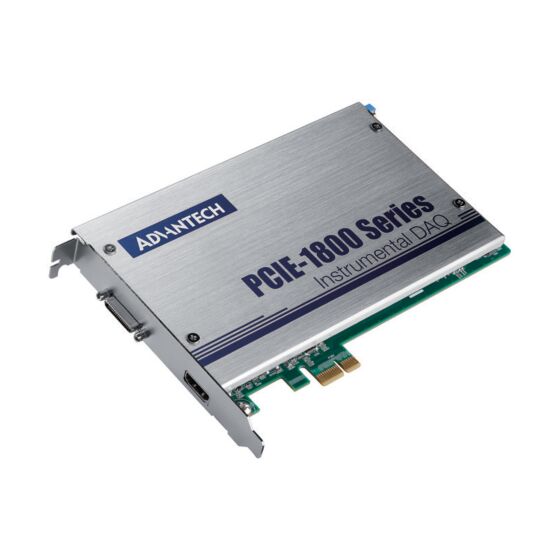
Frequently Asked Questions
The PCIE-1802 has 8 simultaneously sampled analog input channels. The PCIE-1802L variant has 4 channels. Both support differential or 50 Ω pseudo-differential sampling.
The card provides 24-bit resolution (delta sigma) ADCs with a sampling rate range of 100 S/s to 216 kS/s, at a resolution of 363.80 µS/s or better.
Input range is selectable at ±0.2, ±0.5, ±1, ±2, ±5, or ±10 V. Input coupling (AC/DC) is selectable per channel.
Yes. The PCIE-1802/1802L includes built-in software-configurable IEPE excitation current of 0, 4, or 10 mA, selectable per channel, for powering IEPE sensors such as accelerometers and microphones.
The card provides 1 digital input channel (interrupt) and 2 digital output channels.
The card uses a CN600 36-pin mini SCSI connector for analog input, and a CN601 HDMI connector for clock, trigger, and digital I/O signals.
Power consumption is 11.5 W for the PCIE-1802 and 7.5 W for the PCIE-1802L. The datasheet notes that the card may have thermal issues on fanless platforms, and recommends consulting technical support before using it in a fanless system.
The operating temperature range is 0 to 60 °C (32 to 140 °F). Storage temperature range is -40 to 70 °C (-40 to 158 °F), with storage humidity of 5 to 95% RH, non-condensing.
The card measures 168 x 100 mm (6.6" x 3.9") and uses a PCI Express x1 bus interface.
Yes. The card supports multi-card synchronization for applications that require synchronizing more than 8 analog input channels across multiple cards.
How-to Guides
- Identify the CN600 36-pin mini SCSI connector on the card, used for analog input.
- Use a PCL-108BNC-50E cable (mini SCSI to 8-BNC) for the PCIE-1802, or a PCL-104BNC-50E cable (mini SCSI to 4-BNC) for the PCIE-1802L, to break out the analog input channels to BNC connectors.
- Connect IEPE sensors such as accelerometers or microphones to the BNC connectors.
- Configure IEPE excitation current (0, 4, or 10 mA) and AC/DC coupling per channel in software as required by the sensor.
- Locate the CN601 HDMI connector, used for clock, trigger, and digital input/output signals.
- Use the PCL-10119-1E HDMI cable to connect the CN601 connector to external equipment.
- For DIN rail mounted wiring, connect the HDMI cable to a PCLD-8840-AE 20-pin DIN rail HDMI cable wiring board, which is compatible with the PCIE-1802 and PCIE-1840.
- Install multiple PCIE-1802 or PCIE-1802L cards into available PCI Express x1 slots.
- Use the multi-card synchronization feature to link the cards' clock and trigger signals via the CN601 HDMI connectors.
- Use this configuration when synchronizing more than 8 analog input channels across cards.
| Manufacturer | Advantech |
|---|---|
| Short Description | PCIE-1802/1802L is a 24-bit, high-accuracy data acquisition PCI Express module specifically designed for sound and vibration-related applications. This module features built-in 4/10 mA excitation currents for IEPE sensors, such as accelerometers and microphones. |
| I/O | CN600 36-pin mini SCSI (for analog input) CN601 HDMI (for clock, trigger, and DI/Os) |
| Operating Temperature | 0 ~ 60 °C (32 ~ 140 °F) |
| Storage Temperature | -40 ~ 70 °C (-40 ~ 158 °F) |
| Dimension | 168 x 100 mm (6.6" x 3.9") |