
NRU-51V+/51V: Rugged NVIDIA Jetson Orin NX/Xavier NX GMSL2 Camera Sensor Hub for Autonomous Vehicles and Teleoperation
NRU-51V+/NRU-51VStarting at $1,925.00
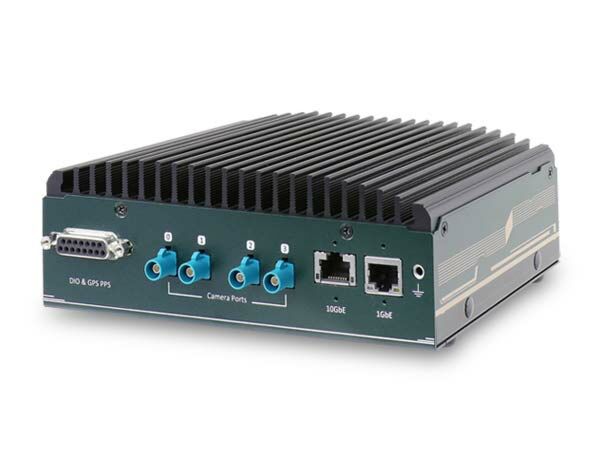
NRU-51V series is a rugged Jetson Orin NX/Xavier NX computer supporting GMSL2 cameras that can act either as a sensor hub or a perception unit for ADAS, teleoperation, autonomous mobile robots, and autonomous vehicles.
- Powered by NVIDIA Jetson Orin NX or Xavier NX SOM bundled with JetPack 5.1.1
- Rugged -25°C to 60°C fanless operation
- Support 4x GMSL2 automotive cameras via FAKRA Z connectors
- 1x 10GBASE-T 10Gb and 1x 1GBASE-T 1Gb Ethernet port
- 2x mini-PCIe sockets for WiFi/GNSS/NVMe/CAN modules
- 1x M.2 3042/ 3052 B key socket for 4G/5G mobile communication
- 1x isolated CAN 2.0, 1x configurable RS232/422/485 port, and 1x GPS PPS input
- 8V to 35V wide-range DC input with built-in ignition power control

Frequently Asked Questions
The NRU-51V+ is built around an NVIDIA Jetson Orin NX system-on-module (Ampere GPU + ARM Cortex CPU) with 8GB or 16GB LPDDR5 memory at 3200 MHz, bundled with JetPack 5.1.1. The NRU-51V uses an NVIDIA Jetson Xavier NX SOM (Volta GPU + Carmel CPU) with 8GB or 16GB LPDDR4x memory (1600/1866 MHz) and 16GB eMMC 5.1 on-module storage, bundled with JetPack 4.6.1.
The system provides 4x GMSL2 FAKRA Z connectors for automotive cameras, 1x 10GBASE-T 10GbE port, 1x 1GBASE-T 1GbE port, 2x USB 3.1/3.2 Gen1 ports, 1x micro USB (OTG/reflash only), 1x DisplayPort (up to 3840x2160 @60Hz), 1x hardware-configurable RS-232/422/485 serial port, 1x isolated CAN 2.0 port, a DIO & GPS PPS connector (1x GPS PPS input, 3-CH isolated DI, 4-CH isolated DO), and 1x M4 chassis grounding terminal.
The system accepts 8V to 35V DC via a 3-pin pluggable terminal block (V+/GND/IGN), which also carries the ignition control signal. Supplying voltage over 35V will damage the system.
The system operates from -25°C to 60°C fanless (15W TDP mode). It can run from -25°C to 70°C fanless if 10GbE transmission is not used, or -25°C to 70°C with the optional fan kit (15W TDP mode). Storage temperature is -40°C to 85°C, humidity 10% to 90% non-condensing. For sub-zero or over-60°C operation, a wide-temperature SSD/NVMe module is required.
The system is rated CE/FCC Class A per EN 55032 and EN 55035. It has been tested for vibration per MIL-STD-810H Method 514.8 Category 4 and shock per MIL-STD-810H Method 516.8 Procedure I (operating conditions).
The NRU-51V+ (Orin NX) has one full-size mini-PCIe socket (PCIe + USB2.0) for an M.2 M-key 2242 NVMe adapter and one full-size mini-PCIe socket (PCIe + USB2.0) for GNSS, V2X, or CAN modules. The NRU-51V (Xavier NX) has one full-size mini-PCIe socket (PCIe + USB2.0) for WiFi/NVMe storage and one full-size mini-PCIe socket (USB2.0 only) for GNSS, V2X, or CAN. Both variants include one M.2 3042/3052 B-key socket (USB 3.1/3.2 Gen1 + USB2.0) for a 4G/5G module, with dual SIM support (one front-accessible micro SIM, one internal).
The NRU-51V+ connects up to 4x GMSL2 automotive cameras via FAKRA Z connectors, supporting 1920x1080 @ 30 FPS input per camera. It includes a synchronization mechanism for acquiring images from all four cameras simultaneously with microsecond channel-to-channel skew, and accepts a GPS PPS input to align image capture with LIDAR or other systems. Compatible camera modules (Sony ISX031, Sony IMX390, Sony IMX490, Onsemi AR0233) are listed as optional accessories with IP67 or IP67+IP69K ratings and various HFOV options.
The NRU-51V/NRU-51V+ chassis measures 173 mm (W) x 144 mm (D) x 60 mm (H) and weighs 1.4 kg. An optional wall-mount bracket kit is available.
Yes. Drivers must be installed to use the GbE port in a Windows environment. The port also supports Wake-on-LAN.
The ignition power control module continuously monitors DC input voltage while the system is running. If the input voltage stays below 11V (for 12VDC systems) or 22V (for 24VDC systems) for a full 60-second duration, the module automatically shuts down the system.
How-to Guides
- Disassemble the system enclosure by removing the six screws on the bottom panel and lifting it open.
- Locate the M.2 B key slot (blue rectangle) and the internal SIM slot (red rectangle), or use the front-panel SIM slot.
- Insert the M.2 module at a 45-degree angle and secure it with a screw, using the copper standoff at the appropriate position for a 2242/3042 or 3052 module.
- Slide open the micro SIM cover, place the SIM card into position, then slide the cover closed to lock the SIM in place.
- Clip the IPEX-to-SMA antenna cable onto the module and secure the antenna connector to the side panel opening.
- Remove the protective film on the thermal pad inside the bottom panel corresponding to the M.2 module.
- Reinstall the system enclosure, panel, and external antenna.
- Disassemble the system enclosure.
- Insert the gold-finger end of the mini-PCIe card at a 45-degree angle into the slot, then gently push the other end down onto the motherboard and secure it with a screw.
- Clip the IPEX-to-SMA antenna cable onto the module (if applicable) and secure the antenna connector to the side panel.
- Remove the protective film on the thermal pad inside the bottom panel corresponding to the mini-PCIe module.
- Reinstall the enclosure when done.
- Confirm the DC source is within the 8V to 35V range; supplying more than 35V will damage the system.
- Connect the vehicle battery + line (12V for sedan, 24V for bus/truck) to the V+ terminal on the 3-pin pluggable terminal block.
- Connect the vehicle battery -/GND line to the GND terminal.
- Connect the ACC (ignition) line to the IGN terminal.
- Ensure the DC power source and IGN signal share the same ground before applying power.
- Disassemble the system enclosure.
- From inside the enclosure, remove the cover over the fan's 4-pin power connector.
- Reinstall the enclosure.
- Place the fan kit on top of the enclosure, secure the two hex screws on the 4-pin connector panel, and plug in the 4-pin power connector.
- Attach the cable cover over the 4-pin power cable using the provided screws.
- Secure the two hex screws on the other side panel to complete installation.
- Remove the four rubber stands from the bottom of the enclosure.
- Take the two wall mount brackets and four M4 screws from the accessory box, and fix the brackets to the system enclosure using the M4 screws.
- Place the system against a flat wall surface and secure it with four M4 screws.
NRU-51V series is a rugged Jetson Orin NX/Xavier NX computer supporting GMSL2 cameras that can act either as a sensor hub or a perception unit for ADAS, teleoperation, autonomous mobile robots, and autonomous vehicles.
By supporting GMSL2 automotive cameras, the NRU-51V+ is equipped with advanced features such as IP67 waterproof, high dynamic range (120dB HDR), auto white balance (AWB), and LED flicker mitigation (LFM). This enables the NRU-51V+ to capture high-quality images with minimal latency, regardless of lighting conditions, from bright sunny days to pitch-black nights. Its unique synchronization mechanism allows it to acquire images from four GMSL2 cameras simultaneously within microseconds of channel-to-channel skew, further enhancing its performance and reliability.
Thanks to the power efficiency of the NVIDIA Jetson Orin NX SOM, the NRU-51V+ can deliver 100 TOPS inference performance in its 25W power package. This means that users cannot only transfer raw camera images through its built-in 10GBASE-T Ethernet for perception processing but also leverage its significant TOPS for real-time object or ROI detection. For teleoperation applications, users can utilize its hardware H.264/265 video codec to encode video streams from four GMSL2 cameras in real-time, transmitting the live video feed to a driver at a remote location via 5G telecommunication with minimum latency.
Combining the GMSL2 interface and Jetson Orin NX makes NRU-51V+ much more than a simple edge AI computer. With greater vision brought by automotive cameras plus I/O interfaces such as 10GbE, CAN 2.0, and M.2 for 5G broadband, NRU-51V+ plays a central role in a moving platform as a sensor hub for ADAS, a perception unit for AGV/ AMR, or a teleoperation controller for off-highway vehicles.
| Manufacturer | Neousys |
|---|---|
| Short Description | NRU-51V series is a rugged Jetson Orin NX/Xavier NX computer supporting GMSL2 cameras that can act either as a sensor hub or a perception unit for ADAS, teleoperation, autonomous mobile robots, and autonomous vehicles. |
| Processor | NRU-51V-NX8/NRU-51V-NX16 NRU-51V+-JON8/NRU-51V+-JON16 |
| Memory | NRU-51V-NX8/NRU-51V-NX16 NRU-51V+-JON8/NRU-51V+-JON16 |
| Video Port | 1x DisplayPort, supporting 3840x2160 at 60Hz |
| DIO | 1x GPS PPS input, 3-CH isolated DI and 4-CH isolated DO |
| M.2 | 1x 3042/3052 M.2 B key (USB 3.1 Gen 1 + USB 2.0) for 4G/5G module with dual SIM support (1x front-accessible, 1x internal) |
| Mini PCI-E | NRU-51V-NX8/NRU-51V-NX16 NRU-51V+-JON8/NRU-51V+-JON16 |
| DC Input | 1x 3-pin pluggable terminal block for 8V to 35V DC input and ignition power control (V+/ GND/ IGN) |
| Dimension | 173 mm (W) x 144 mm (D) x 60 mm (H) |
| Weight | 1.4kg |
| Mounting | Wall-mount bracket (optional) |
| Operating Temperature | With full CPU+GPU stressing: -25°C to 60°C fanless operation (15W TDP mode)* *For sub-zero and over 60°C operating temperature, a wide temperature SD card / NVMe is required. |
| Storage Temperature | -40°C to 85°C |
| Humidity | 10% to 90%, non-condensing |
| Vibration | Operating, MIL-STD-810H, Method 514.8, Category 4 |
| Shock | Operating, MIL-STD-810H, Method 516.8, Procedure I |
| EMC | CE/FCC Class A, according to EN 55032 & EN 55035 |