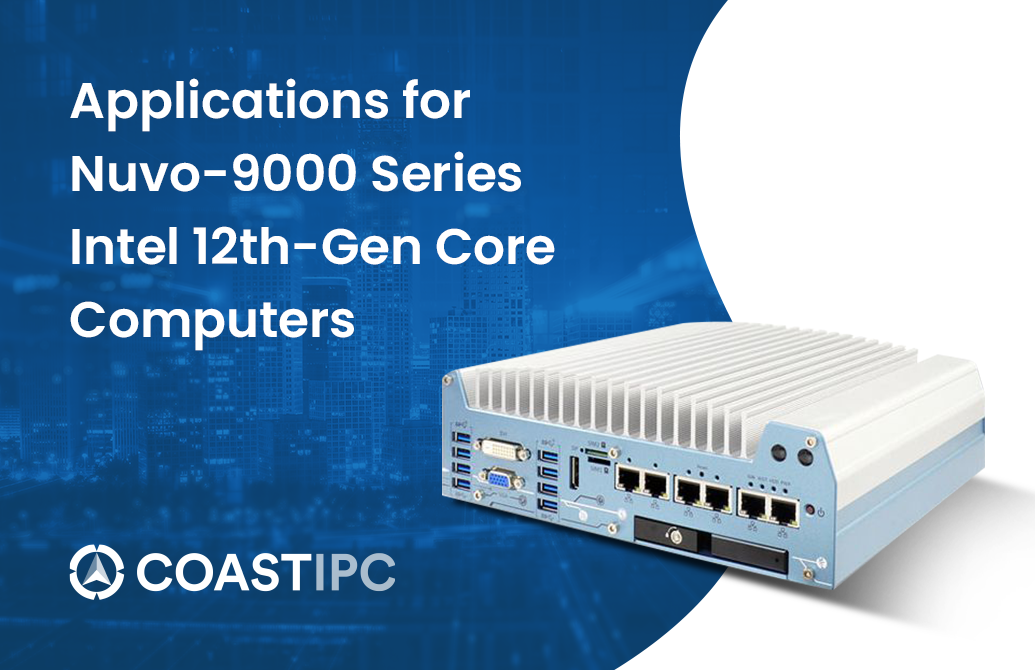
NRU-120S NVIDIA Jetson AGX Xavier AI Platform
NRU-120SNEW PRODUCT AVAILABLE
The NRU-120S is a rugged industrial PC designed for intelligent video analytics. One of the main highlights of this PC is its low energy usage, making it ideal for many remote applications. Its power is provided by the NVIDIA Jetson AGX Xavier SOM and includes JetPack 4.4. The Jetson AGX Xavier module has an 8-core ARM CPU and NVIDIA Volta GPU with 512 CUDA cores and 64 Tensor cores that offer 11 TFLOPS FP16 or 22 TOPS INT8 computing power.
- Powered by NVIDIA Jetson AGX Xavier SOM bundled with JetPack 4.4
- 4x IEEE 802.3at Gigabit PoE+ ports with screw lock
- 2x front-accessible, hot swappable 2.5" HDD/SSD trays
- 1x mini-PCIe socket for WiFi/4G module
- 1x isolated CAN bus port and 1x RS-232 port with flow control
- 1x GPS PPS input, 3-CH isolated DI and 4-CH isolated DO
- 8~35V wide-range DC input with built-in ignition power control

Frequently Asked Questions
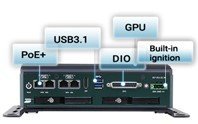
The NRU-120S front panel includes 4x IEEE 802.3at Gigabit PoE+ ports, 2x USB 3.1 Gen1 ports, 1x DisplayPort, a digital I/O port (1x GPS PPS input, 3-CH isolated DI, 4-CH isolated DO), an ignition control switch, and a 3-pin terminal block for DC input. Two front-accessible 2.5" HDD/SSD trays are also on the front panel.
The rear panel includes a CAN bus port, an RS-232 port, an additional DisplayPort, a USB 3.1 Gen1 port, and a reserved micro-USB port for reflashing. Camera ports and the 10GbE port shown in the manual are only available on the NRU-110V, not the NRU-120S.
The NRU-120S accepts 8~35V DC input through a 3-pin pluggable terminal block (IGN/GND/V+). The same terminal block is used to supply the ignition control signal. Supplying a voltage over 35V will damage the system.
The NRU-120S has 4x IEEE 802.3at Gigabit PoE+ ports via an Intel I350 controller, each capable of delivering up to 25W to a powered device. At 70°C ambient with the GPU under full load and USB at 20W load, the total PoE+ power budget drops from 100W to 68W. The system has a 16A over-current protection design; to maximize PoE+ output, supply the NRU-120S with more than 12V.
The NRU-120S operates from -25°C to 50°C with passive cooling in MAX TDP mode, -25°C to 70°C with passive cooling in 30W TDP mode, and -25°C to 70°C with the optional fan kit in all modes. Storage temperature is -40°C to 85°C, with 10%~90% non-condensing humidity. It carries CE/FCC Class A certification per EN 55032 & EN 55035, and meets MIL-STD-810G vibration (Method 514.7) and shock (Method 516.7) test standards. Note that sub-zero or above-60°C operation requires a wide temperature HDD or SSD.
The NRU-120S has 32GB onboard LPDDR4x memory and 32GB eMMC 5.1 on the module. For storage expansion it offers 2x front-accessible 2.5" HDD/SSD trays (up to 9.5mm height) and 1x M.2 2280 M-key slot (PCIe Gen3 x2) for an NVMe SSD. It also has a full-size mini PCI Express socket with an internal SIM socket for a WiFi or 4G module.
The NRU-120S has a full-size mini-PCIe socket with an internal SIM slot. This allows installation of a mini-PCIe module for WiFi, GPS, CAN bus, or an analog frame grabber, or a 3G/4G module with a SIM card for cellular internet access. Multiple SMA antenna apertures are located on the rear panel for wireless communication.
The DIO port provides 1x GPS PPS input, 3-CH isolated digital input (DI), and 4-CH isolated digital output (DO). The DO uses an open-drain design where output voltage is determined by an external power source (recommended 5V to 24V). The DI interprets 0 to 1.5V as logic 0 and 5 to 40V as logic 1. In Linux, each GPIO is mapped to a virtual folder, and PPS0 is defined in the official device tree.
The NRU series is shipped with NVIDIA JetPack 4.4 pre-installed as a turnkey solution. The system can be reflashed with NVIDIA's official JetPack 4.4 or with a Neousys pre-built system image using a host machine running Ubuntu 18.04.2 LTS and NVIDIA SDK Manager.
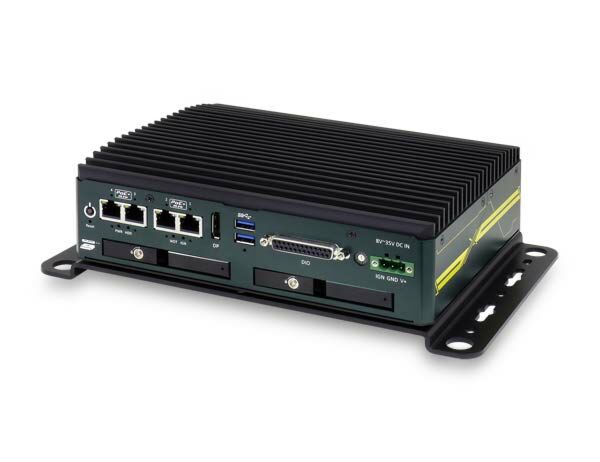
The NRU-120S measures 230 mm (W) x 173 mm (D) x 66 mm (H) and weighs 2.7 kg, excluding the damping bracket. It ships with Neousys' patented damping (anti-vibration) bracket as standard mounting equipment.
The ignition power control module is an MCU-based system that monitors the IGN signal and turns the system on/off based on a configurable power-on and power-off delay, selectable via a 16-position rotary switch (modes 0-15). It supports low battery detection, guarded power-on/off delay cancellation, a hard-off safety mechanism, and a smart off-delay feature in modes 13 and 14. IGN input accepts 8~35VDC.
How-to Guides
- Disassemble the system enclosure.
- Remove the internal panel/heat spreader by unscrewing the screws on its sides.
- Insert the NVMe SSD into the M.2 2280 M-key slot (PCIe Gen3 x2) at a 45° angle.
- Gently push the SSD down toward the motherboard and secure it with the supplied screw.
- Reinstall the internal panel by securing the screws on both sides.
- Reinstall the enclosure when done.
- Pull the lever to open the front-accessible 2.5" HDD/SSD tray.
- Insert the HDD/SSD with the label facing upwards, SATA connector side first into the slot. Push firmly until it is fully seated (attach the included PORON spacer if installing a 7mm drive).
- Push the lever into the slot until it snaps into position.
- Use the key provided in the accessory box to lock the external slot if desired.
- Disassemble the system enclosure.
- Locate the mini-PCIe slot and the SIM card slot on the motherboard.
- Insert the gold-finger end of the mini-PCIe card at a 45° angle into the slot, then gently push the other end down onto the motherboard and secure it with two screws.
- To install the SIM card, push the SIM card slot toward the battery and flip open the SIM card holder.
- Insert the SIM card and secure the holder by sliding it away from the battery.
- Reinstall the enclosure when done.
- Confirm the DC power source is within 8~35V DC before connecting; supplying over 35V will damage the system.
- Connect the vehicle Battery + line (12V for sedan, 24V for bus/truck) to the V+ terminal.
- Connect the vehicle Battery -/GND line to the GND terminal.
- Connect the ACC (accessory/ignition) line to the IGN terminal.
- Ensure the DC power source and IGN signal share the same ground.
- Remove the four rubber stands at the bottom of the enclosure.
- Secure the anti-vibration mount to the bottom of the enclosure using the provided M4 screws and sleeves.
- Mount the system on a flat, sturdy surface using the anti-vibration mount.

With the gradual advancement of AI, the demand for image computing has increased that led to the development of edge computing for roadside applications. In response, Neousys enters the market with NRU-120S, an efficient compact fanless edge AI inference platform featuring NVIDIA Jetson AGX Xavier™ that can deliver performances equivalent to a 120W GPU in under 30W. NRU-120S’ processing prowess include video recording and transcoding, to real-time inference at the edge. It perfectly meets the needs of intelligent video analytics, real-time law enforcement, autonomous robots, inspection robots, smart agriculture, etc.
30W Fanless Edge AI Prowess
The NVIDIA Jetson AGX Xavier features an 8-core ARM CPU, NVIDIA Volta GPU with 512 CUDA cores and 64 Tensor cores to offer 11 TFLOPS FP16 or 22 TOPS INT8 of computing power in under 30W. With a wide range of cost-effective NVIDIA AI tools and deep learning frameworks, NRU-120S pushes real-time image and video inference to the edge.
Robust and Reliable
With an exclusive mechanical and efficient thermal design, the NRU-120S can operate under 100% CPU/GPU load in extreme conditions. Moreover, it accepts 8-35V wide-range voltage input and comes with a damping kit, screw-lockable PoE+ ports; making it reliably suited for harsh outdoor environments or in a moving vehicle.

Compact and Power Efficient
Measuring only 230 mm (W) x 173 mm (D) x 66 mm (H), it is ultra-compact and consumes under 30W to deliver performances equivalent to a 120W GPU, making it ideal for solutions that are space and power-constrained but require performance. Solutions such as roadside units for intelligent surveillance, V2I (vehicle to infrastructure) and field robots such as agricultural robots/ cleaning robots/ last-mile delivery robots, etc.
Rich Input/Output
NRU-120S offers 4x PoE+ ports and 3x USB ports for IP, industrial and USB cameras; two hot-swappable 2.5" storage trays for ease of accessibility at the edge and it also features various in-vehicle functions such as ignition control, CAN bus, and one mini-PCIe socket for WiFi/ 4G module. Furthermore, there are 1x GPS PPS input, 3-CH isolated DI and 4-CH isolated DO for communication with external
APPLICATION FIELDS
VIDEO ANALYTICS
AUTONOMOUS ROBOTS
LAW ENFORCEMENT
AGRICULTURE
NRU-120S series is a new rugged edge AI-based video analytics solution capable of video recording, transcoding, real-time inference, etc. Powered by NVIDIA® Jetson AGX Xavier™ system-on-module (SOM), it comprises of an 8-core ARM CPU and NVIDIA® Volta GPU with 512 CUDA cores and 64 Tensor cores that offer 11 TFLOPS FP16 or 22 TOPS INT8 computing power.
Benefiting from the low-power design of NVIDIA® Jetson AGX Xavier™, NRU-120S offers significant inference performance while consuming only 30W of power. The efficient power design and the compact form factor make it the perfect edge AI solution for both stationary and mobile applications.
NRU-120S offers four 802.3at Gigabit PoE+ ports; each port can supply up to 25.5W of power to PD devices such as IP cameras and industrial cameras. In addition to 32GB eMMC on the Xavier module, NRU-120S further incorporates two front-accessible, hot-swappable 2.5" HDD/ SSD tray for expanding storage capacity and an M.2 2280 NVMe socket for fast SSD read/write performance. It also has one mini-PCIe socket for WIFI and 4G module, as well as 4-CH isolated DI and 4-CH isolated DO for communication with external devices.
By integrating PoE+ connectivity, a wide range of NVIDIA® AI tools, and modern deep learning frameworks, NRU-120S pushes real-time image and video inference to the edge. It is a one-stop AI-based video analytics solution that offers 802.3at PoE+ camera connections, video decoding, video streaming, video recording, and edge AI inference. With Neousys' unique damping bracket design, ignition power control, and wide voltage power supply, NRU-120S is an ideal video inference platform for autonomous machines, predictive maintenance, law enforcement, and smart city applications.
| Product Available On | Sep 16, 2020 |
|---|---|
| Manufacturer | Neousys |
| Processor | Supporting NVIDIA® Jetson AGX Xavier™ System-on-Module, comprising of NVIDIA® Volta GPU and Carmel CPU |
| Memory | On board 32GB LPDDR4x @ 2133 MHz |
| PoE | 4x IEEE 802.3at (25.5W) Gigabit PoE+ ports by Intel® I350 |
| Video Port | 2x DisplayPort, supporting 3840x2160 at 60Hz |
| DIO | 1x PPS input. 3-CH isolated DI and 4-CH isolated DO |
| M.2 | 1x M.2 2280 M key socket (PCIe Gen3 x2) for NVMe SSD |
| Mini PCI-E | 1x full-size mini PCI Express socket with internal SIM socket |
| SATA HDD | 2x hot-swappable HDD tray for 2.5” HDD/SSD installation (up to 9.5mm height) |
| DC Input | 1x 3-pin pluggable terminal block for 8~35V DC input (IGN/ GND/ V+) |
| Dimension | 230 mm (W) x 173 mm (D) x 66 mm (H) |
| Weight | 2.7 kg (excluding damping bracket) |
| Mounting | Wall-mount with damping brackets (Standard) |
| Operating Temperature | -25°C ~ 50°C with passive cooling (MAX TDP mode) * -25°C ~ 70°C with passive cooling (30W TDP mode) * -25°C ~ 70°C with optional fan kit (all modes) * |
| Storage Temperature | -40°C ~ 85°C |
| Humidity | 10% ~ 90%, non-condensing |
| Vibration | Operating, MIL-STD-810G, Method 514.6, Category 4 |
| Shock | Operating, MIL-STD-810G, Method 516.6, Procedure I, Table 516.6-II |
| EMC | CE/FCC Class A, according to EN 55032 & EN 55024 |
| CPU Cores | 8 |
| CPU Family | Jetson AGX Xavier |
| Video Output | Display Port |
| PoE Ports | 4 |
| LAN Ports | 1-4 |
| Serial Ports | 1-2 |
| USB 3.0 | 3-4 |
| Max Memory | 32 GB |
| Operating System | Windows 10, Linux |
| Effective Memory Speed | 2400 MHz |
| Form Factor | Fanless |
| Native Storage Type | 2.5" SSD, M.2 NVMe SSD |
| On/Ignition | Built In Ignition Control |