
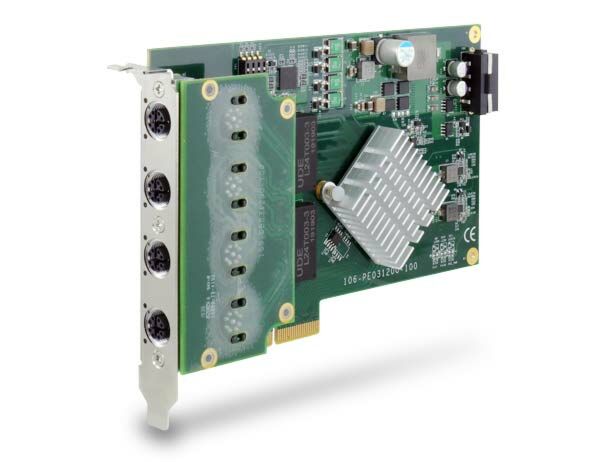
4x GbE PoE+ Expansion Card with M12 Connectors
PCIe-PoE312MMain Features:
- Intel I350 server-grade Gigabit Ethernet controller
- Four M12 x-coded connectors with patent-pending housing design
- x4, Gen2 PCI Express interface offering 2GB/s total bandwidth
- Compliant with IEEE 802.3at to deliver up to 25.5 W per port
- Supports 9.5 kB jumbo frame, teaming and IEEE 1588
- Per-port PoE+ power on/off control

Frequently Asked Questions
The PCIe-PoE312M has 4 Gigabit Ethernet ports, implemented via a server-grade Intel® I350-AM4 NIC. Each port also functions as an IEEE 802.3at (PoE+) power sourcing port, capable of delivering up to 25.5W to a connected powered device. Ports use M12 x-coded connectors housed in a CNC-milled aluminum block for ruggedness.
The card draws a maximum of 1.2A at 3.3V from the PCI Express bus. For its PoE+ function, it requires up to 9.6A at 12V, which can be sourced either from the PCI Express bus or from an on-board 4-pin power connector, depending on how much current your motherboard's PCIe slot can supply.
The card is rated for 0°C to 55°C operation with air flow.
The card measures 167 mm (L) x 111 mm (H) x 20 mm (W). Note that it is slightly thicker than a standard PCIe card, so it should be treated as a dual-slot card, and it is recommended to leave the adjacent slot empty.
The card requires CAT-5e or CAT-6 cable, with a maximum cable length of 100 meters.
The card uses an x4 Gen2 PCI Express bus interface. It can also be installed in a compatible x16 PCI Express slot if your host computer's slot can be configured as a PCI Express Root Port; check with your computer vendor to confirm compatibility.
Drivers are provided for Windows XP, Windows 7, and Windows 8/8.1 (both 32-bit and 64-bit versions), included on the Neousys Drivers & Utilities DVD.
Yes. The card includes a DIP switch (P1-P3) to set a unique Board ID (0-7) for each installed card, allowing the per-port PoE on/off control API to address each card individually.
The PCIe-PoE312M supports manual per-port power on/off control for each of its PoE ports via provided function APIs (PCI_GetStatusPoEPort, PCI_EnablePoEPort, PCI_DisablePoEPort). This lets you manually reset connected PoE+ powered devices, for example for fault-recovery or device power-reset purposes.
How-to Guides
- Locate the DIP switch in the upper-left corner of the PCB.
- Use switches P1-P3 to set the desired Board ID (0-7) according to the DIP switch position table.
- Use this Board ID as the boardId parameter when calling the per-port PoE on/off control API functions if you have multiple PCIe-PoE312M cards installed.
- Determine whether your motherboard's PCI Express connector can supply the required 9.6A maximum current for PoE+ operation.
- If not, set the P4 DIP switch position to draw 12V DC from the on-board 4-pin power connector instead of the PCI Express connector.
- If using the 4-pin power connector as the source, connect it to a standard ATX power supply cable before powering on the system.
- Configure the Board ID DIP switch if necessary (see section 4.1).
- Configure the 12V DC source DIP switch if necessary (see section 4.2), and connect the 4-pin power connector if that source is selected.
- Open the chassis of the host computer and expose an available x4 PCI Express slot (or a compatible x16 slot).
- Align and insert the card's golden-finger connector into the PCI Express slot.
- Secure the card in place to finalize installation.
- Insert the Drivers & Utilities DVD into a DVD drive attached to the host computer.
- When the setup utility launches, click "Automatic Driver Installation".
- Wait for the utility to detect your operating system and install the appropriate drivers (approximately 2-3 minutes).
- Allow the setup utility to reboot the system; the card will be ready for use after reboot.
- After installing the Intel I350 GbE driver, open Network Connections and double-click the corresponding Local Area Connection.
- Click Configure, then select the Advanced tab in the property dialog.
- Select the Jumbo Packet setting and choose the desired frame size (9014 Bytes is suggested for high data rate devices such as GigE cameras).
-
 MIC-770 Advantech MIC-770 Compact Fanless System with 8th Gen Intel Core i CPU
Starting at $1,695.00
-
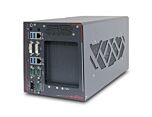
 Nuvo-8240GC Series Nuvo-8240GC: Edge AI Platform Supporting Dual Tesla T4 GPUs
Starting at $2,085.00
-
 Nuvo-8034 Series Nuvo 8034: Neousys Rugged Embedded Computer with 7 PCIe/PCI Slots
Starting at $1,545.00
-
 MIC-730AI MIC-730AI Inference System with NVIDIA Jetson AGX Xavier
Starting at $4,110.00
-
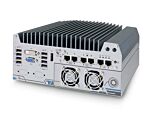
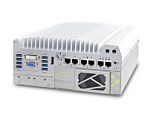
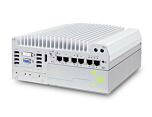
 Nuvo-8000 Nuvo-8000 Series Intel 9th/8th-Gen Core Box-PC with up to 5 PCIe/ PCI Slots
Starting at $1,130.00
-
 Nuvo-9000E/P/DE Nuvo-9000E/P/DE: Intel 14th/13th/12th-Gen Rugged Embedded Computer
Starting at $1,620.00
- MIC-770 Advantech MIC-770 Compact Fanless System with 8th Gen Intel Core i CPU
Starting at $1,695.00
- Nuvo-8240GC Series Nuvo-8240GC: Edge AI Platform Supporting Dual Tesla T4 GPUs
Starting at $2,085.00
- Nuvo-8034 Series Nuvo 8034: Neousys Rugged Embedded Computer with 7 PCIe/PCI Slots
Starting at $1,545.00
- MIC-730AI MIC-730AI Inference System with NVIDIA Jetson AGX Xavier
Starting at $4,110.00
- Nuvo-8000 Nuvo-8000 Series Intel 9th/8th-Gen Core Box-PC with up to 5 PCIe/ PCI Slots
Starting at $1,130.00
- Nuvo-9000E/P/DE Nuvo-9000E/P/DE: Intel 14th/13th/12th-Gen Rugged Embedded Computer
Starting at $1,620.00